
New white paper | Power system resilience
Physical Protection: The Foundation of Electrical Resilience
Critical transformers can suffer irreversible damage within the first milliseconds. Restoring equivalent capacity may take months or years — and a multi-asset crisis can overwhelm spare parts, logistics, response teams and insurance capacity.
- Understand the gap between failure and recovery times.
- Identify non-substitutable assets and multi-site domino risks.
- Connect cyber, electrical, physical, fire and recovery layers.
40 pages
English
Evidence-led
For utilities, insurers & public authorities
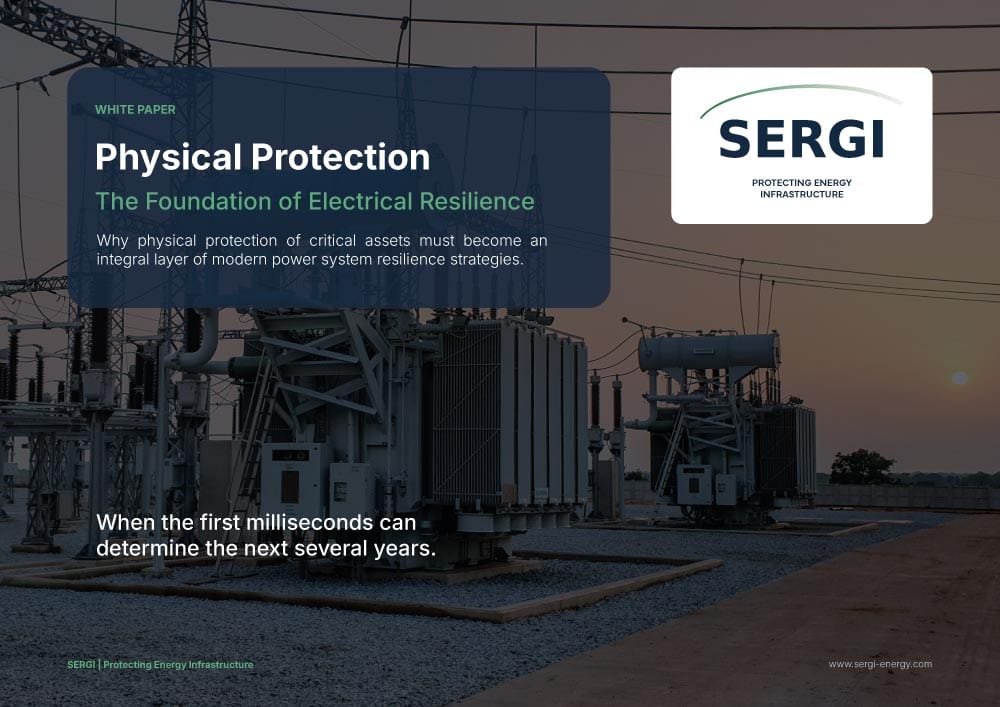
When the first milliseconds can determine the next several years.
Critical transformer resilience, multi-asset risk and recovery.
40-page white paper
System-level resilience
Evidence-led
Four audience pathways
Why this matters now
Three shifts are redefining transformer resilience.
The risk is no longer limited to the value of one asset. It is shaped by the speed of physical escalation, the difficulty of replacement and the accumulation of losses across multiple sites.
First milliseconds. Months or years to recover.
The real test begins when several assets fail at once.
Cyber risk can become physical risk.
What you will learn
A practical framework for moving from asset risk to system resilience.
The report combines physical mechanisms, multi-layered protection, field evidence and executive decision criteria.
Prioritize critical transformers
Address the physical risk window
Assess multi-asset exposure
Move from awareness to action
Built for decision-makers
One report. Four perspectives.
Each audience can enter the resilience discussion through the decision it is responsible for.
UTILITY & GRID
Utilities, TSOs, DSOs & infrastructure operators
INSURANCE
Insurers, reinsurers, brokers & risk engineers
PUBLIC POLICY
Governments, regulators & public authorities
INDUSTRY
Industrial operators, data centers, EPCs & OEMs
Inside the report
A 40-page framework for resilience decisions.
Preview four of the core visual arguments developed in the white paper.
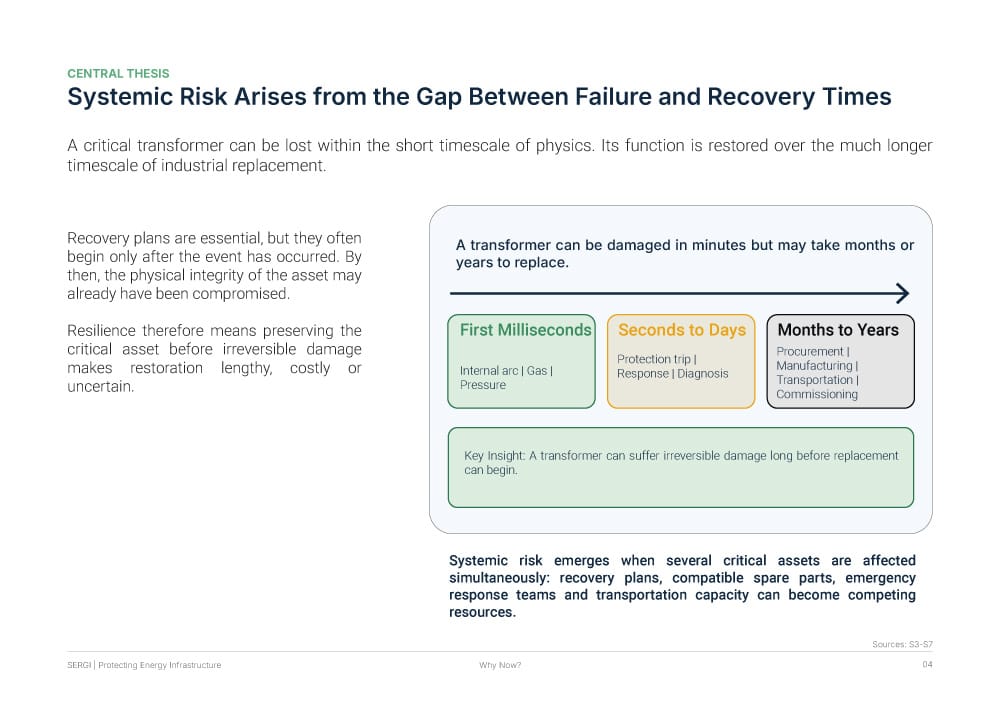
Time asymmetry
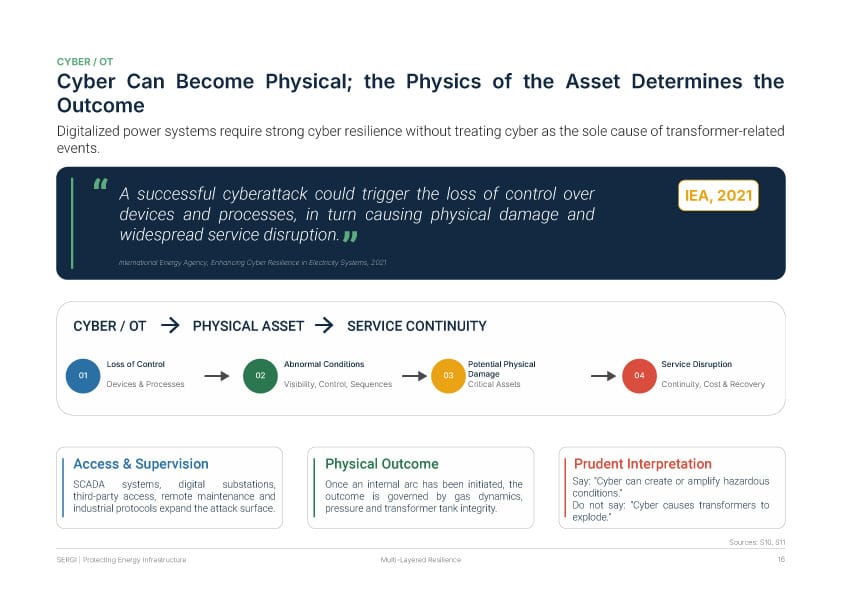
Cyber can become physical
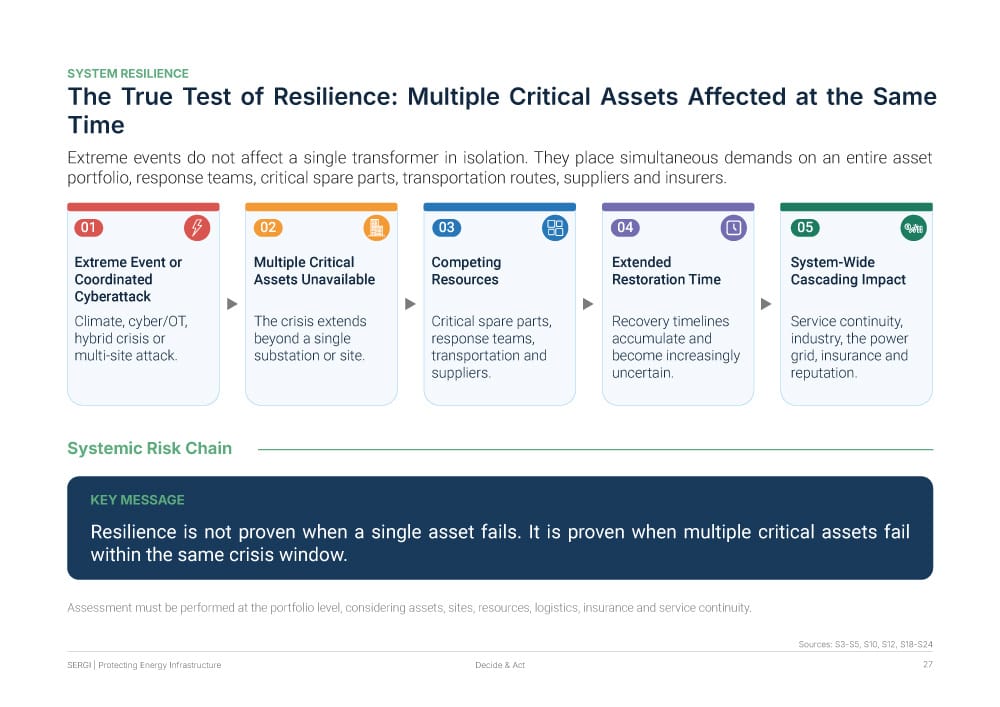
The multi-asset domino effect
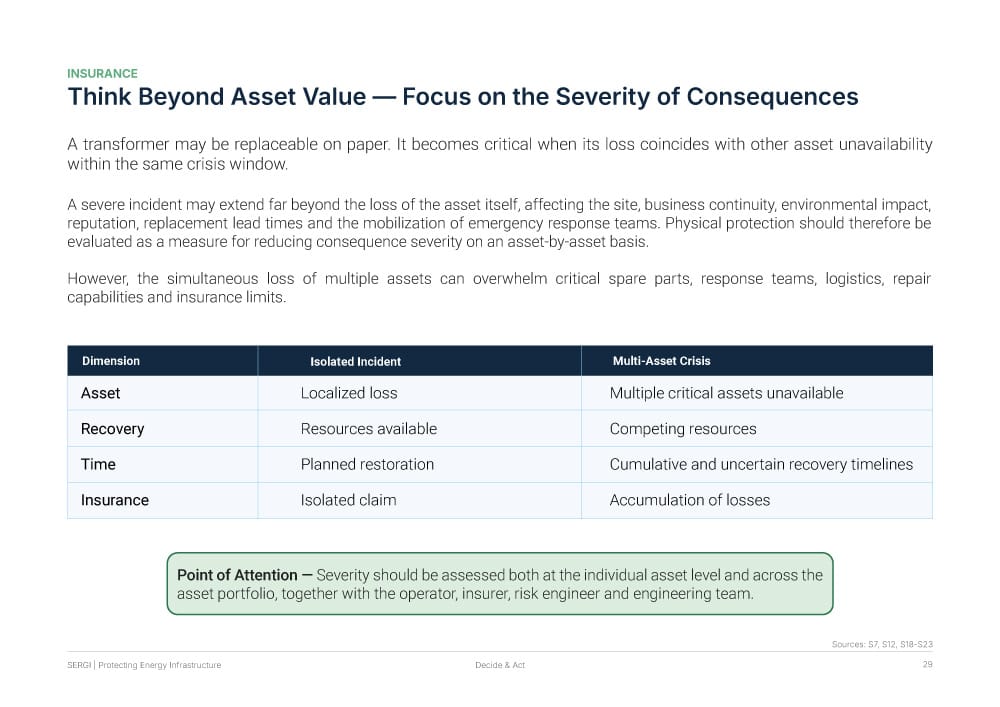
Insurance and loss accumulation
Evidence base
Built on complementary layers of evidence.
The report uses the right source for the right message: system context, technical mechanisms, testing, field applications and engineering experience.
IEA
U.S. DOE
IEEE
CIGRE
EDF
CEPEL
Bureau Veritas
The report references these organizations and publications. It does not claim endorsement or approval by them.
System context
Physics of risk
Testing & independent validation
Field applications
SERGI engineering experience
SERGI engineering experience
Engineering for critical energy infrastructure.
SERGI works alongside utilities, industrial operators, insurers and public authorities when high-consequence risks require project-specific engineering rather than a standard approach.
4,000+
Installed systems
85+
Countries
20+ years
Continuous operation
ISO
9001 | 14001 | 45001
SERGI-validated operational data — presented as installed experience, not as a universal performance guarantee.
'Field engineering | Critical environments'
Download the full report
Get immediate access to the 40-page white paper.
Receive the full report and an executive summary. Select your profile so SERGI can share the most relevant follow-up content.
- Immediate PDF access after form submission.
- Optional briefing tailored to utilities, insurers or public authorities.
- No technical project details or phone number required.
Download the White Paper
After the download
Continue with the conversation that matches your role.
UTILITY / INDUSTRY
Technical or Project Briefing
INSURANCE
Insurance & Risk Engineering Briefing
PUBLIC AUTHORITIES
Institutional Resilience Briefing

Protecting Energy Infrastructure. Engineering physical resilience for critical transformers and high-consequence energy environments.
Contac
SERGI Transformer Protector
48–52 avenue des Châtaigniers
95150 Taverny, France
www.sergi-energy.com
© 2026 SERGI Transformer Protector. All rights reserved.


