



- Home
- Critical Infrastructure
- Definition & Stakes
Definition & Stakes
When critical infrastructure fails, consequences extend far beyond the asset itself.
Disruptions to critical infrastructure can rapidly impact public safety, economic stability and national security — often across multiple sectors simultaneously.
What is Critical Infrastructure?
Critical infrastructure refers to the systems and assets that are so essential to a society’s functioning that their destruction or incapacitation would have debilitating effects on public health, safety, the economy, and national security.
In highly interconnected energy systems, infrastructure failures are rarely isolated events. They propagate across networks, geographies and services.
Across all critical sectors, dependence on reliable electrical infrastructure is increasing — while tolerance for failure continues to decline.
80% of the world’s population is directly reliant on the electrical grid.
Airports, railways, and metro networks are vital for urban mobility and the global economy.
The backbone of digital networks, storing and processing vast amounts of critical data.
Ensuring clean and reliable water supply is critical for public health and industrial processes.
80% of U.S. grid transformers imported
Supply-chain consolidation and global manufacturing constraints have led to more than 80% of U.S. grid transformers being imported — increasing replacement times and systemic vulnerability in the event of failure.
Supply-chain consolidation has seen over 60% of U.S. grid transformers imported.
WHEN A TRANSFORMER FAILS…
Why Power Transformers Are System-Critical Assets
Large power transformers are essential for global energy transmission networks, ensuring power conversion and voltage regulation across long distances. They enable stable, reliable electricity supply for cities, industries, and critical facilities. Their failure can cascade across interconnected systems, making recovery complex, slow, and costly.
Their bespoke design, long manufacturing lead times and complex integration make power transformers among the most difficult assets to replace after a failure.
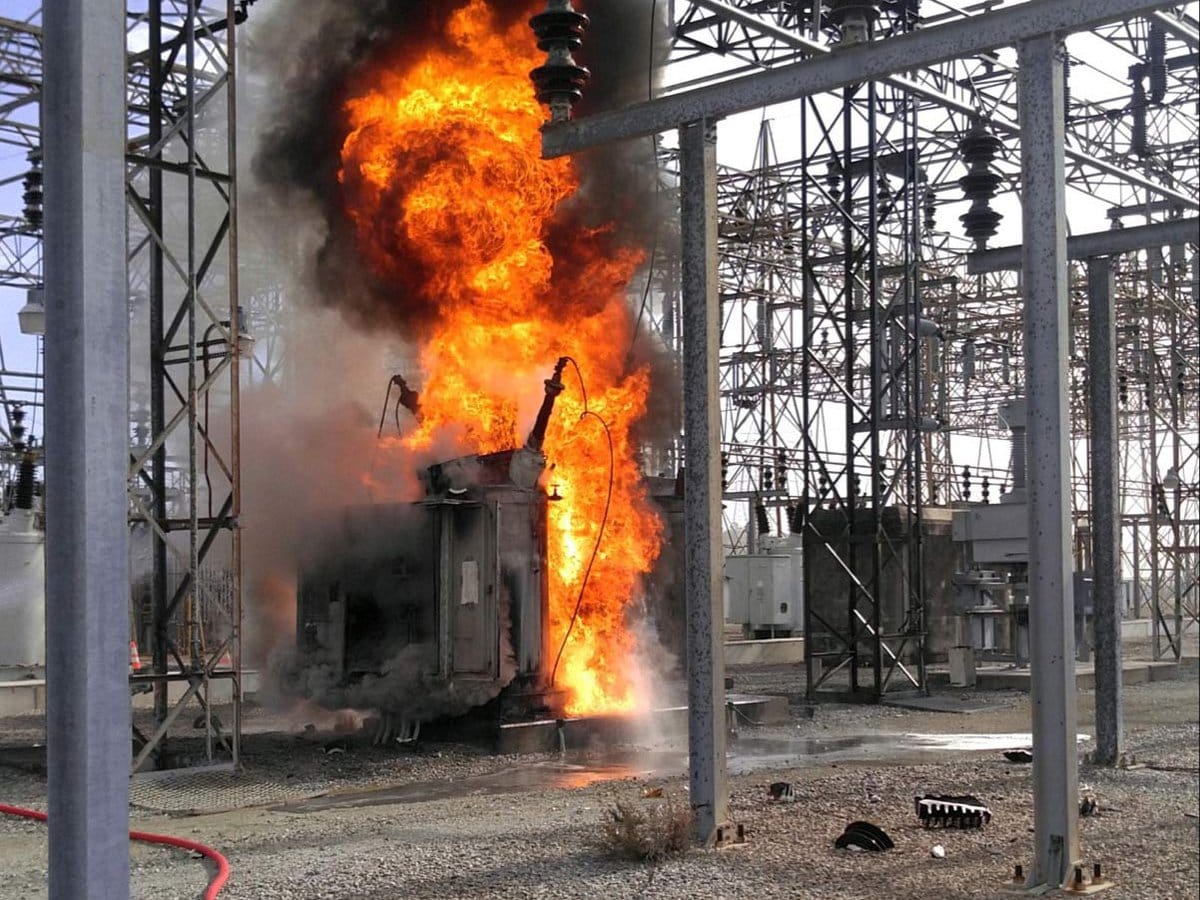
When uncontrolled, transformer failures can escalate into violent explosions, fires and long-term site damage — amplifying safety, environmental and continuity risks.