



Engineering protection for critical power infrastructure
SERGI is an engineering partner focused on the protection of critical power infrastructure and the resilience of electrical networks, supporting continuity of service.
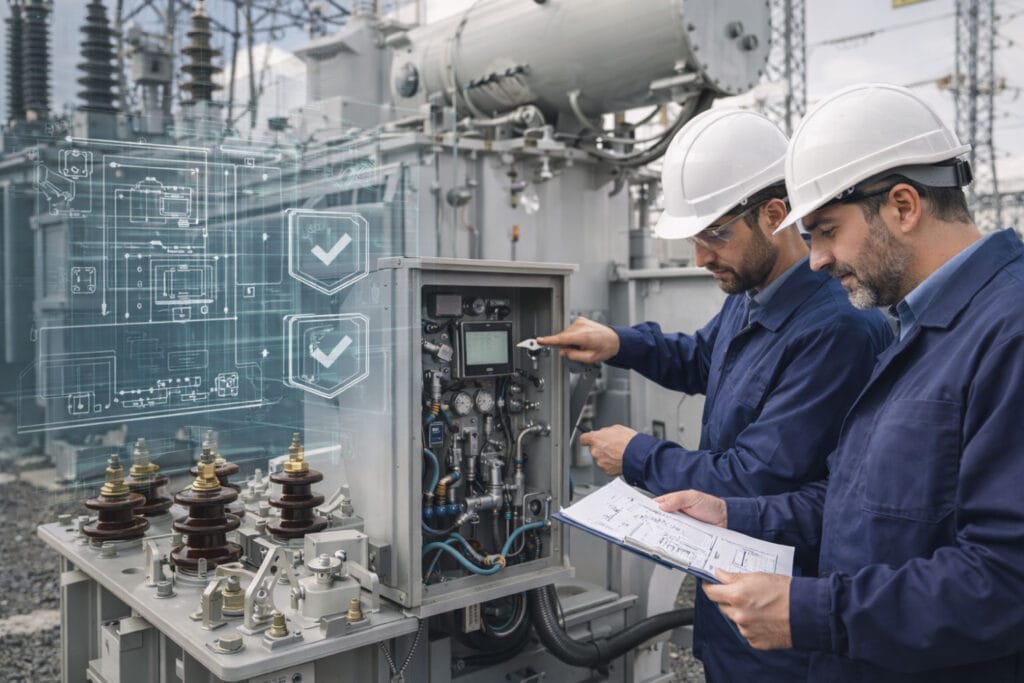
Critical power infrastructure as a system-level challenge
Electrical networks underpin essential services, industrial activity and public safety. They operate under increasing pressure: ageing assets, higher utilisation, evolving regulatory expectations and growing scrutiny on resilience and continuity of service.
In this context, large power transformers and associated installations cannot be considered in isolation. Their criticality is defined by the role they play within the electrical network as a whole. When incidents occur, their impact can extend beyond the affected asset, influencing safety, environmental exposure, adjacent equipment and network operation.
Protecting critical power infrastructure therefore requires a system-level perspective, focused not on eliminating the possibility of failure, but on understanding risks, limiting consequences and supporting the resilience of electrical networks.
From asset protection to network resilience
Historically, protection strategies have often focused on individual components. Today, utilities increasingly recognise that resilience is a property of systems, not of single assets.
A system-level approach considers:
- how incidents may propagate within an installation,
- how adjacent equipment and personnel can be protected,
- how network architecture and operational practices influence outcomes,
- and how protection measures align with broader continuity-of-service objectives.
This shift reflects a mature understanding shared across the industry: continuity of service is not equivalent to uninterrupted operation of every asset, but to the ability of the network to continue fulfilling its essential function.
Why engineering matters in protecting critical infrastructure
Effective protection of critical power infrastructure relies on engineering discipline rather than isolated technical solutions. Engineering-led approaches integrate physical phenomena, site-specific constraints, network configuration and operational realities into a coherent framework.
Such approaches are built on a combination of analytical studies, controlled testing and accumulated field experience. This foundation allows engineering teams to understand failure mechanisms, assess potential consequences and design protection strategies that are consistent with real-world operating environments.
By grounding protection decisions in engineering analysis, utilities can better align risk mitigation measures with safety, environmental and regulatory requirements, while supporting long-term resilience objectives.
SERGI’s positioning
SERGI operates within this framework as an engineering partner to infrastructure owners and operators.
Our positioning reflects a clear focus:
SERGI is an engineering partner focused on the protection of critical power infrastructure and the resilience of electrical networks, supporting continuity of service.
Rather than addressing protection as a standalone technical topic, SERGI contributes to a structured understanding of risks and system interactions. This engineering-led perspective supports utilities in integrating protection measures into the broader context of network design, operation and long-term asset management.
Supporting continuity of service – without overpromising
Continuity of service is a central objective for electrical networks. It is inherently systemic and depends on multiple factors, including redundancy, operational preparedness, organisational processes and network architecture.
From an engineering standpoint, supporting continuity of service involves limiting the scale and severity of incident consequences, protecting adjacent equipment, reducing safety and environmental risks, and enabling effective network reconfiguration and recovery strategies.
Engineering-based protection approaches contribute to these objectives by helping utilities anticipate how incidents may affect installations and networks, and by supporting measures that reduce their broader impact. They complement, rather than replace, operational and organisational resilience strategies.
A long-term engineering commitment
The challenges facing critical power infrastructure will continue to evolve over the coming decades. Addressing them requires long-term engineering consistency, realistic risk assessment and close alignment with the operational realities of utilities.
SERGI’s approach is grounded in this long-term perspective. By focusing on engineering-led protection and system-level resilience, SERGI supports utilities in navigating complex and evolving infrastructure challenges, while contributing to continuity of service as a shared, long-term objective.
Request further information
If you would like to learn more about SERGI’s engineering approach to the protection of critical power infrastructure and network resilience, please complete the form below.
This page is intended to provide institutional and technical context. It does not constitute a commercial offer or a guarantee of performance.