



- Home
- Solutions & Engineering
- Transformer Protection
- Transformer Protector (TP)
Transformer Protector (TP)
The Mechanical System Designed to Fulfil the Last Line of Defense
When the decision has been made that a transformer cannot fail, the Transformer Protector is the engineered mechanical response.
This system is deployed when internal faults must be contained before explosion and fire occur — without relying on electrical detection or external power.
Where the Transformer Protector Fits
Transformer protection is a system-level strategy.
The Transformer Protector is one of its most critical executions.
Risk & system analysis
Prevention & mitigation
Transformer Protector
The Transformer Protector is not a generic safety device.
It is installed only when the asset criticality justifies a mechanical system acting within milliseconds, independently from all electrical protections.
What it does
- No electrical signal
- No external power
- No software or logic layer
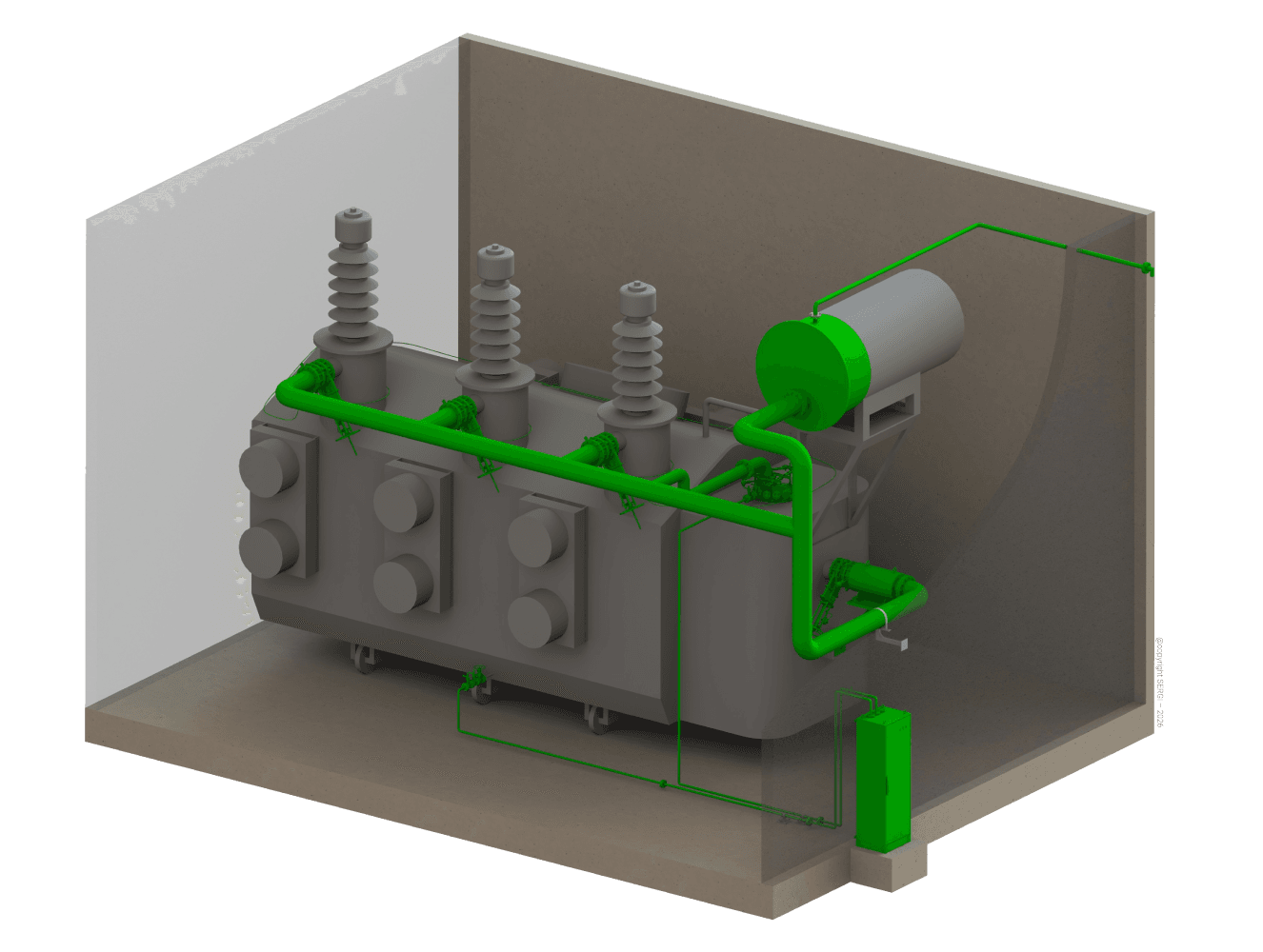
Passive. Mechanical. Non-electric.
Designed to operate when everything else is exceeded.
A mature, field-proven explosion prevention technology
The Transformer Protector is not an experimental solution. Its passive, mechanical pressure-relief principle has been validated through full-scale live testing and more than two decades of operational deployment on critical transformers worldwide.
When Is the Transformer Protector the Right Choice?
The Transformer Protector is typically selected when:
- The transformer is classified as critical in the asset strategy
- Failure would lead to human, environmental, or systemic risk
- Replacement time is measured in months or years
- The installation requires a non-electric, passive solution
Typical applications
- Generation step-up transformers
- Transmission substations
- Nuclear power plants
- Critical, urban or industrial substations
Discuss how explosion prevention can be engineered for your transformer configuration and risk profile.